


THE COST OF PROGRESS: Nanay Nelly's Story of Survival Amidst Displacement
- Jonell Gregorio

- Jan 5
- 3 min read
What happens when a woman who once survived a missile strike is forced to survive poverty all over again?
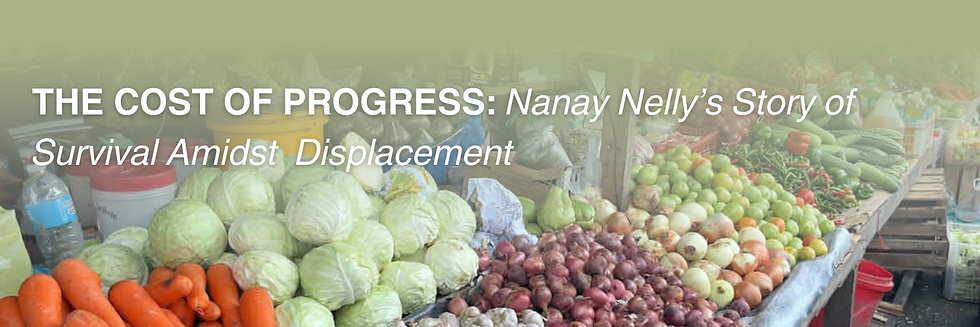
Nanay Nelly never imagined that after living through war zones, navigating foreign employers and working across borders, her hardest battle would be fought here at home. Not with explosions in the sky, but with vegetables laid across crates beside a busy Kalibo sidewalk where most people walk past without stopping.

From War Zones to Overseas Labor
Before she became a vendor facing shrinking sales and displacement, 69-year-old Nanay Nelly Valdoz was an Overseas Filipino Worker. For seven years in Lebanon, she cleaned homes and cooked meals while learning to live with the sound of bombs. She recalls sleeping lightly, because even silence felt dangerous.
Nothing compares, however, to the night she almost died.
It was her day off. She treated herself to a manicure, a tiny act of joy after endless days of labor. As she and her husband prepared to sleep on the rooftop unit of a 16-storey building, a missile crashed into their kitchen.
“Uwa gid’a kami’t makita kato,” she recalled. “Dueom dueom.”
They escaped only because her husband smashed through an air-conditioning unit and pulled her out. Syrian police later came, asking questions. The bomb, she learned, came from Israel.
She survived the war. She survived grief, including the heartbreak of failing to come home when her mother died, because her passport was never processed. And eventually, she survived more years of foreign labor—in Lebanon, in Greece, and in Singapore, all to build a home and a better life for her children.
A Return Home and a Different Kind of Battle
Nanay Nelly has been a vegetable vendor since 1997. For decades, she has relied on early mornings, foot traffic, and luck. Some days, she earned just enough for rice. Some days, nothing.
Still, she found pride in her sacrifices. One of her children finished a degree in Computer Science because of her. But the other only made it to his second year and never finished.
“Sangkiri lang gid kunta ag napatapos ko eon imaw… Galing alinon mo hay kinueang eon gid du kwarta.” she whispered, swallowing guilt she shouldn’t carry.
Displaced, Cramped, and Forgotten
Then came a blow she never expected—not from missiles, but from market development.

The Kalibo Public Market, where she worked for years, underwent renovation. Vendors were told to leave their stalls. There were promises of return, but no clear plan. Instead, they were downgraded to a tight, uncomfortable strip of space beside the street, exposed to heat, rain, and traffic.
Customers stopped coming. Some vendors took better spots along the sidewalk, blocking visibility. And then, customers started choosing the Juliana Public Market, where stalls are brighter, cleaner, and easier to navigate.
Now, she wakes at dawn only to earn sometimes ₱100 a day — sometimes nothing.
“Syempre na depress kami tag gin halin kami bigla, nagpakalisod kami para igto kami ag haeos igto eon kami nabuhay.
Survival Has Many Faces
Her story reminds us that survival does not end when danger ends.
War taught Nanay Nelly to run. Poverty taught her to endure. Displacement taught her how easily livelihood can be taken — even in a “safe” home.
She once survived a missile. Now, she survives being unseen.
Holding On to Hope
Despite everything, she still dreams of one thing — to have her stall back, where customers once knew her name.
“Basta ang gusto,” she says softly, “nga mabuhi kami nga may sangkiri nga ginhawa… bago ako maduea sa kalibutan.”
Her voice, steady yet fragile, lingers in the air — a reminder that resilience has a face, and it is lined with years of sacrifice.
Nanay Nelly is just one of many vendors affected by the sudden change. Here are more of other people affected by the displacement;


Comments