


From Vine to Vision: The Ron Martesano Story
- Jonell Gregorio

- Jan 5
- 9 min read
By Samantha Nicole N. Macahilig and L E V. Andrade

"Habang gabuhay hay nagiging masadya man ako.”
These words spoken with a quiet smile by 48-year-old Ron Martesano, reveals the soul of a man who refuses to be defined by his chair. While his legs have long since surrendered, his strength remained still, and his hands move with precision. Ron lives in Barangay Aranas, Balete, Aklan, where a contrast defines his life: a body that rests, and a spirit that never stops climbing. He is a living testament that physical limitations do not define one’s potential.
For 25 years. Ron’s fingertips tamed the stubborn Nito fern. He doesn’t just sit; he wrestles with the tough, biting fibers of the mountain vines until they bend to his will.
This mastery in the heart of Balete did not stay hidden for long. His journey of resilience soon leaped from the shadows of his sanctuary into the national spotlight.
It did not just catch the eyes of the people around him. His story resonated so deeply that it reached the digital pages of Rappler and Explained PH.

Rappler’s feature highlights Ron’s physical tenacity, following his grueling treks into Aranas’ mountains to harvest wild Nito Vines. It captures the math of survival. where an hour of intense manual labor yields to a single intricately crafted plate.

Explained PH delves into Eayang-Eayangan’s journey into a transformed economic powerhouse. It details their journey from zero capital to supplying art in luxury hotels in Boracay and international markets in South Korea.
But there are always two sides to a coin: the struggle behind the success.
The Moment the World Stilled
Ron was not born to sit. Like every other child, he was only a little boy eager to navigate the depths of the world. At seven years old, he would sprint through the dust of his barrio, his legs carrying him through every adventure.
But a single moment in first grade fractured his life.
During the rush of recess, as kids ran all over the place, Ron was accidentally hit by a schoolmate. The collision sent him falling to the ground and a seemingly small tumble that spiraled into a nightmare.
"Naconfine rayun ako sa hospital", Ron recalls.
Back then, advanced medicine was a luxury, pockets were empty, and a simple injury festered. His legs, once high spirited, gradually surrendered to the grip of polio.

This tragedy silenced the playground and prevented him from continuing his education.
"Syempre indi man maduea nga maibog sa ibang unga kato dati nga gahampang, nasubuan man ako", he confessed.
Yet, his home never lost its spark.


Ron and his family gather around the table, sharing a home-cooked meal and a conversation and the end of the day.
Ron's family became his pillars, refusing to let his world shrink. They nurtured him through his darkest days, providing the love and support he needed to ensure he was never truly left behind.
But in those days of stillness, Ron discovered a new rhythm. While his legs rested, his hands began to explore the tough, wiry textures of the Nito fern.
While the walls of his home offered safety, Ron craved purpose. He didn't just want to pass the time; he wanted a way to anchor his life to a stable income and a sense of belonging.
"Gusto ko man makabulig,"Ron says.
The Double Burden: From Pity to Economic Violence
When viewed in a sociological sense, Ron faces “The Double Burden of Stigma”: when viewed as an object of pity and being undervalued as a laborer. As noted in social studies in the Global South, PWDs in agrarian societies often face a ‘devaluation of labor.’
The devaluation of labor is the process of reducing the economic and social value of work through strategies like fragmentation, standardization (Taylorism), and desiring to lower costs and increase productivity.
From the moment of his accident in first grade, the world began to view Ron through the lens of “loss.” The accident of his paralysis led many to believe that his life already ended before it even began. This is the medicalization of identity, where a person is seen only through their diagnosis. Ron recalls the “silent playgrounds” as a metaphor for a society that didn’t know how to include a child who couldn’t run. This stigma of “incapacity” is what Ron actively fights. To be seen as a leader and not as a patient.

As Ron mastered the Nito craft, the stigma evolved from pity to economic marginalization. When a tourist or local buyer asks for a discount and attempts to haggle down a masterfully woven plate down to a price that barely covers the material, they are not just haggling over pesos; they are performing an act of Symbolic Violence.
This suggests that because Ron is a PWD, his labor is “therapeutic” rather than “professional”. It implies that he should be grateful for any act of pity, ignoring the manual tension and 25 years of mastery required for the craft. Ron’s fight for a fair price is a strike against the systemic belief that “disabled labor” is worth that “abled labor.”
Eayang Eayangan: Making the Heavy Light

In the local Aklanon dialect, the name Eayang Eayangan means a sense of lightness or ease. The name carries a quiet defiance. In a world that often makes disability feel heavy economically, socially, and emotionally, this association exists to redistribute that weight through collective strength.
Eayang Eayangan was formed not simply as a livelihood group, but as a response to stigma. Where individuals like Ron were once isolated, undervalued, or forced to negotiate under unfair pricing and pity-driven assumptions, the association creates a shared ground where dignity is protected.
It is an organization made by PWDs for the PWDs. Reflecting the association's core philosophy; that through collective support, the heavy burdens of a disability can be made into light. It embodies the transition from their struggle of an individual to the strength of a community.


Inside the Eayang Eayangan, a vibrant display features finished Nito handicrafts, including intricately woven baskets and desk organizers that showcase the community's artistry; at the center are dedicated team members Jenson Dominguez, Woody Francisco, Faith Gallarzdez, and Regino Dominguez stand together in the workshop; and finally, a close-up of the PWD Balete Association sign stands as a proud mark of local craftsmanship and the "Support Lokal" movement.
Eayang Eayang acts as a fair-trade hub where the association sets a standard price for products, ensuring no member is exploited. By fixing prices collectively, the association rejects the belief that work done by PWD's is "therapeutic" rather than professional.
"Kung amat, may ga hinyo nga abi singkwenta lang mana, kaisot malang hay. Tapos ka't datong maisot, tatlong oras ko inubra," Ron sighed.
Each woven plate, basket, or craft item carries not just hours of labors, but decades of mastery.
The association works closely with the Department of Trade and Industry (DTI). In which they don't just weave souvenirs; they create high-end artisanal products.


With a total of 809 PWD members in Balete, Eayang Eayangan stands as one of their lifelines. In which Ron stands as the leader of all PWDs in Aranas.
Here, members can access small loans for medical emergencies or to buy raw materials. The workshop is also a space where Ron and others share more than craft; they share the lived experience of navigating the world with "This-Ability," providing a sense of belonging that is often missing in rural areas.


From left to right: Members of the PWD Balete Association join Vice Governor Dexter M. Calizo to showcase their craftsmanship during the 47th National Disability Rights Week at the Mayor Teodoro F. Calizo, Sr. Memorial Civic Center; Ron Martesano, a skilled artisan, represents the talent and entrepreneurial spirit fostered by the association; and finally, our PWD artisans express their heartfelt gratitude to Sir Saom T. Namchu and the group from GFF Helps Philippines for visiting and purchasing Nito products on November 17, 2025. This visit was made possible by Lady Rameneses and her family, who brought the group to our PWD Display Center at the Eayang Eayangan Multi-Sectoral Building, providing vital support that empowers our community and the dedicated work of artisans like Ron.
In this space, leadership replaces pity. Workers become decision-makers. And stigma once internalized as silence is confronted through collective action. Eayang Eayangan with the help of Balete's local government does not erase disability but reframes it. What society tried to reduce to weakness, the community rebuilds into power.
HAND CRAFTED NITO PRODUCTS


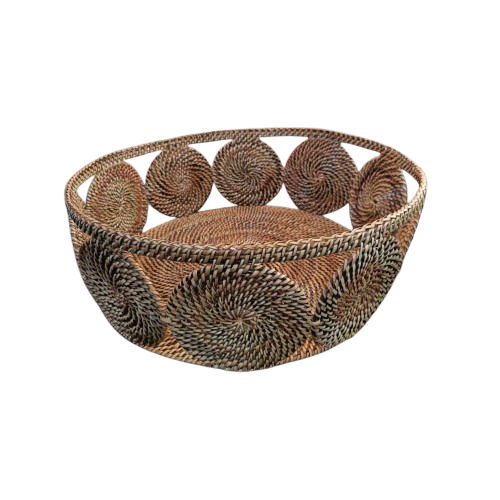


Eayang Eayangan purchases items from workers for prices ranging from ₱300 to ₱2,000. These goods are then sold on the international market at a premium, with half of the earned profits being returned to the workers.
Sowing, Stamping, and Sustaining: Ron's Daily Hustle

Ron's life woven from more than just Nito vines; it is a tapestry of diverse labors. Tucked within his home is a sari-sari store, a small vital hub where he manages the daily needs his neighbors.
But his service doesn't stop at storefront.
As the village cobbler, he mends the worn soles and weary sandals of his neighbors. He asks only eighty pesos for his craft, a haunting irony for a man whose own feet have long been still, yet his hands continue to facilitate the journey of others.
While outside, his sanctuary expands into a thriving garden.
Parts consisting of a variety of vegetables that anchor his kitchen to the earth. His mornings begin where he tends to his ducks and chickens, waking before the sun to ensure that every living thing under his care is feed.
But when the sun dips low, the tools, and needles are put away, Ron's free time becomes a symphony of rest.
Even in rest, Ron remains in motion. A government-provided e-bike has transformed how he moves through the rough roads of Balete, turning once-exhausting distances into manageable journeys.
With it, he delivers finished Nito products, runs daily errands, and visits neighbors on his own terms.
The Digital Stage Stage: Vlogging the "This-Abled" Life
When the Nito vines are laid to rest and the cobbler's stool grows cold, Ron dins a different kind of "Eayang Eayangan" (lightness) in the palm of his hand. His free time isn't just for quiet reflection; it is for connection. As an aspiring content creator, Ron turns his smartphone into a digital window, vlogging his daily life for a growing community on Facebook.
In a clip from one of his Facebook reels, Ron is seen varnishing his finished Nito products, preparing them for Eayang Eayangan to be exported to international markets.
"Kung ako abi isaea hay mahilig gidang mag bidyo bidyo,"he expressed. "Bisan kiri malang gatanaw hay, manami man sa pamatyagan makipag isturya bisan sa comments."
Accustomed to the gaze of journalists and filmmakers, Ron commands the camera with ease, offering eloquent insights into his life while actively pursuing content creation as a modern pastime.

While the digital world and his various trades offer connection, it is the Nito vine that remains the truest mirror of Ron's life. The vine is much like the man himself: overlooked by many as a mere weed of crags, yet possessing a tensile strength that, when handled with mastery becomes something of immense values.
Ron does not just weave plates; he weaves a safety net for those the world tried to leave behind. Every time he pulls a fiber tight, he is exerting a power over the "Double Burden" of his life. He has moved beyond medicalization of his identity.
Ron is no longer a patient to be cured, but a master to be consulted.
The success of Eayang Eayangan ensures that the economic violence of the past is replaced by the lightness of the future. By securing a fair share of both national and international profits, Ron and his fellow weavers have proven that their labor is not a form of therapy, but a professional contribution to the global market.
As the evening light fades over the mountains of Aranas, Ron's hands finally rest. The vines have been tamed, the patterns are set, and the weight of the day's work feels different than the eight of the accident forty years ago. One was a burden imposed by fate; the other is weight he chooses to carry, a craft that anchors his community and his worth.
He returns to that simple, resonant truth, a statement that serves as both his starting point and his destination.
"Habang gabuhay hay masadya ako."
Through the threads of the Nito, Ron Martesano's vision has found more than a livelihood. He found a way to make the heavy word light, one vine at a time.


Comments